
21-08-2026

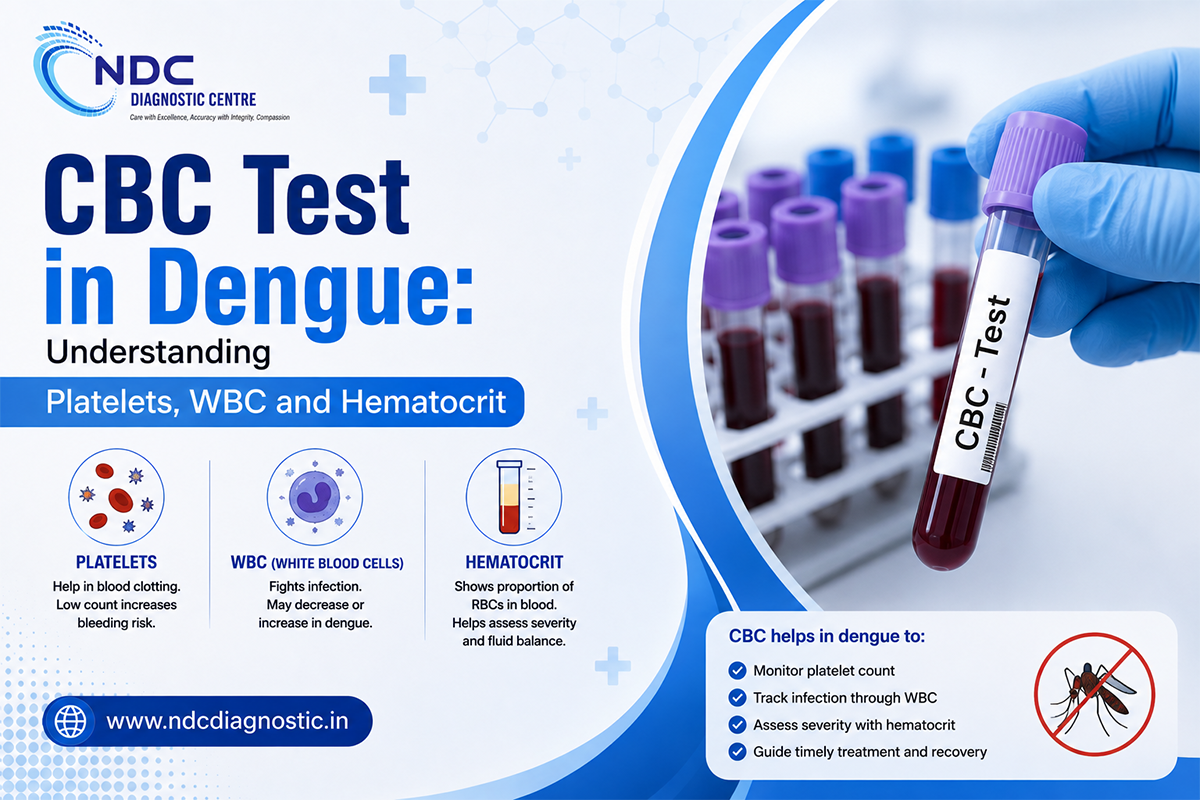
CBC Test in Dengue: Understanding Platelets, WBC and Hematocrit

Introduction — Why Your CBC Report Matters During Dengue 

For many people with dengue, the first number they look at on a CBC report is the platelet count. But doctors do not assess dengue severity from platelets alone.

A CBC test in dengue gives your doctor a window into several different aspects of your blood at the same time. It tracks platelets, white blood cells, hematocrit, hemoglobin and other blood-cell measurements — all in one go. The real value of a dengue CBC report is not any single number but the pattern of changes across multiple parameters and how those changes compare over time.

What matters most is the trend — and your clinical condition. A platelet count seen in isolation, without considering your symptoms, hematocrit movement and overall health, tells only a small part of the story. If you have been advised to undergo blood tests, you can explore the pathology and blood testing services at NDC Diagnostic Centre to get accurate, timely results.

CBC in Dengue: What Does the Test Measure? 

A complete blood count (CBC) test measures the cellular components of your blood. In the context of dengue, not every parameter carries equal weight. Doctors focus particularly on four key measurements.

Platelet Count

Platelets are tiny blood cells that help your blood clot. In dengue, the platelet count often falls — a condition called thrombocytopenia. This is one of the most recognised changes in a dengue blood test, and it is closely monitored throughout the illness. However, the degree of drop and the rate at which it is falling matter far more than any single reading.

White Blood Cell Count

White blood cells are your body's infection-fighting cells. During dengue, the total white blood cell count often decreases — a condition called leukopenia. A low WBC in dengue is a commonly observed finding, and it can be one of the early signals that something viral is happening, though it is not specific to dengue alone.

Hematocrit

Hematocrit measures the proportion of your blood that is made up of red blood cells, expressed as a percentage. In dengue, hematocrit changes can be clinically important. When plasma — the liquid part of blood — leaks out of blood vessels, the concentration of red blood cells relative to the remaining fluid increases. This is called hemoconcentration, and a rising hematocrit can be a significant warning sign when assessed alongside other findings.

Hemoglobin and Red Blood Cells

Hemoglobin reflects the oxygen-carrying capacity of your blood and is closely tied to red blood cell levels. In dengue, hemoglobin values may shift in response to changes in fluid balance and hemoconcentration. These values are interpreted alongside hematocrit and clinical condition rather than in isolation.

What Happens to CBC Values During Dengue? 

The table below gives a general overview of the CBC changes that can be seen in dengue. Keep in mind that not every patient follows the same pattern, and individual results must always be interpreted by a healthcare professional.

CBC Parameter

Common Trend in Dengue

Why Doctors Watch It

Platelets

May decrease

Trend helps monitor illness progression

WBC

Often decreases during acute illness

Leukopenia is commonly seen with dengue

Hematocrit

May rise with plasma leakage

Rising trend can indicate hemoconcentration

Hemoglobin

May change with fluid balance and hemoconcentration

Interpreted with hematocrit and clinical condition

The CDC identifies leukopenia, thrombocytopenia and hemoconcentration among laboratory findings commonly seen with dengue. These three parameters together — not just platelets — form the core of what a doctor watches in a dengue CBC report.

Why Do Platelets Drop in Dengue? 

Dengue commonly causes thrombocytopenia — a drop in platelet count. There are several reasons this happens. The dengue virus can affect the bone marrow, where platelets are produced, slowing down their production. At the same time, immune responses during dengue can cause platelets to be destroyed or consumed faster than normal. The result is a falling platelet count that needs to be monitored carefully.

It is important to understand that the platelet decline in dengue does not happen in a straight line for every patient. Some people see a gradual fall; for others, the drop can be faster. What is clinically meaningful is the direction of change, how quickly it is falling and what is happening with other parameters — particularly hematocrit — at the same time.

A falling platelet count should always be assessed alongside symptoms and other laboratory findings, not treated as the only number that matters.

When Do Platelets Usually Start Falling?

Platelet decline is generally associated with the progression of dengue illness. Rather than pinpointing an exact day that applies to every patient, it is more accurate to say that platelet counts tend to start falling as the illness advances beyond the early febrile phase and can continue to decline into what clinicians describe as the critical phase. The timing varies between individuals, and this is one reason why serial CBC testing — repeated over time — is more useful than a single snapshot result.

When Do Platelets Start Recovering?

Platelet recovery generally occurs during the recovery phase of dengue, but timing varies from person to person. The CDC notes that in the recovery phase, the white blood cell count often begins to rise before platelet recovery begins. This pattern — rising WBC followed by rising platelets — is a reassuring sign of the body moving toward recovery. However, the pace of recovery differs between individuals, and platelet counts do not always rise in a perfectly straight line every day.

Is Platelet Count the Most Important Number in Dengue? 

No. No single CBC value should be interpreted alone.

This is perhaps the most important point in understanding how a dengue CBC report should actually be used. Many people — and unfortunately, some online sources — focus entirely on platelet count and try to judge dengue severity from that number alone. This approach is incomplete and can be misleading.

Doctors assess dengue using a broader picture that includes:

  • Platelet trend — Is the count falling slowly or rapidly?
  • Hematocrit trend — Is it rising, suggesting hemoconcentration?
  • Blood pressure — Is there any sign of circulatory compromise?
  • Hydration and fluid balance — Is the patient adequately hydrated?
  • Bleeding — Are there any signs of mucosal or other bleeding?
  • Abdominal pain — Is there tenderness in the abdomen?
  • Vomiting — Is the patient able to keep fluids down?
  • General clinical condition — How does the patient look and feel overall?

A rapid platelet decline together with a rising hematocrit is recognised as an important warning pattern in dengue. These two changes together — falling platelets and rising hematocrit — carry far more clinical weight than either measurement on its own. A patient with a moderately low platelet count but a rapidly rising hematocrit may need closer attention than a patient whose platelets are lower but whose hematocrit is stable and who is clinically well.

This is why your dengue blood test results should always be reviewed by your treating doctor rather than interpreted using online platelet-count charts.

Why Does WBC Count Decrease in Dengue? 

Leukopenia — a reduced white blood cell count — is a finding commonly seen with dengue. The dengue virus can suppress the production of white blood cells and affect how the immune system behaves during acute infection. As a result, WBC count in dengue tends to be lower than normal during the active phase of illness.

It is worth understanding that a low WBC alone does not diagnose dengue. Other viral infections can also cause leukopenia. The finding needs to be assessed alongside clinical symptoms, the course of the fever, platelet count, hematocrit and, where appropriate, dengue-specific tests such as NS1 antigen or IgM antibody testing.

WBC trends can also change during different phases of illness. A falling WBC during the febrile and critical phases may shift direction as the patient moves toward recovery.

When Does WBC Start Recovering?

WBC typically begins to recover during the recovery phase of dengue. As mentioned earlier, the CDC describes a pattern where the white cell count often starts rising before platelets recover. This is a useful clinical marker of improvement. However, the timing of WBC recovery varies, and individual results should always be interpreted by a healthcare professional familiar with the patient's full clinical picture.

Why Is Hematocrit Important in Dengue? 

Hematocrit is one of the most important yet often underappreciated parameters in a dengue CBC report. While most conversations about dengue focus on platelet counts, experienced clinicians pay close attention to hematocrit — sometimes even more so.

Hematocrit represents the percentage of your blood volume that is occupied by red blood cells. Under normal circumstances, this percentage stays within a relatively stable range. But in dengue, plasma — the liquid component of blood — can leak out of blood vessels into surrounding tissues. When this happens, the volume of plasma decreases, but the number of red blood cells remains similar. As a result, red blood cells make up a higher proportion of what remains in the blood vessels, causing the hematocrit percentage to rise.

This is called hemoconcentration, and it is one of the key features that doctors monitor in dengue. Doctors often compare a patient's current hematocrit with a baseline value — either a previous reading or an age- and sex-appropriate reference — to assess whether a meaningful rise has occurred.

What Does Rising Hematocrit Mean in Dengue?

A rising hematocrit in the appropriate clinical context can indicate that plasma leakage is occurring. WHO guidance identifies plasma leakage and hemoconcentration as key features associated with severe dengue. When hematocrit is rising at the same time that platelets are falling, and the patient is showing warning signs such as abdominal pain, vomiting or restlessness, this combination warrants prompt medical attention.

It is not the hematocrit number alone that matters — it is the direction and rate of change, combined with the patient's symptoms and other CBC findings.

Is High Hematocrit Always Severe Dengue?

No. A single hematocrit value should not be self-interpreted.

Hematocrit can be influenced by baseline hydration, body composition and other factors unrelated to dengue. A person who was mildly dehydrated before the blood draw may show a slightly higher hematocrit without plasma leakage being the cause. This is why baseline values, the trend over serial tests and the clinical context matter. A healthcare professional needs to put the hematocrit number into the full picture before drawing conclusions.

Platelet Count vs Hematocrit: Which Matters More in Dengue? 

This is a question many patients and families ask, and it is worth addressing directly. The honest answer is: both matter, and they should be interpreted together.

Platelet Count

Hematocrit

Helps track thrombocytopenia

Helps assess hemoconcentration

Can fall significantly during dengue

May rise with plasma leakage

One number alone does not determine severity

Must be interpreted against baseline and trend

Should be interpreted with clinical findings

Especially meaningful alongside other warning signs

A patient with a very low platelet count but stable hematocrit and no warning signs is in a different clinical position from a patient with a moderately low platelet count combined with a rapidly rising hematocrit and abdominal pain. Both patients need medical attention, but the clinical approach may differ.

Doctors interpret platelet count and hematocrit together rather than treating them as competing numbers. Watching both parameters — along with WBC, hemoglobin and the patient's symptoms — gives a more complete picture of what is happening during dengue illness.

Can a CBC Test Confirm Dengue? 

No. A CBC can show blood-count patterns compatible with dengue and help monitor a patient, but it does not confirm dengue infection by itself.

This is one of the most important distinctions to understand about the dengue blood test. CBC changes like low platelets, low WBC and rising hematocrit are supportive findings — they are consistent with dengue — but they are not specific to dengue. Other infections and conditions can produce similar CBC changes.

To confirm dengue, dengue-specific tests are needed. Here is how the key tests differ:

CBC

Used to assess blood-cell parameters, identify patterns consistent with dengue and monitor trends over time. Essential for ongoing management but not for confirming the diagnosis.

NS1 Antigen Test

The NS1 antigen test detects a specific dengue virus protein in the blood. It is used as a dengue-specific diagnostic test and is generally most useful during the early days of illness when the antigen is detectable. It can help confirm active dengue infection within the appropriate phase of illness.

Dengue IgM Test

The IgM antibody test detects the immune response to dengue infection. Because IgM antibodies take time to develop after infection begins, this test is typically more useful slightly later in the illness. It is often used alongside NS1 or other tests depending on how many days the patient has been unwell.

Molecular Testing / NAAT

Nucleic acid amplification testing (NAAT) detects dengue viral RNA directly and is highly specific. It is used where available and clinically appropriate, particularly in the early phase of illness. The CDC's current diagnostic guidance recommends dengue-specific testing — such as NAAT plus IgM, or NS1 antigen plus IgM — for confirming acute dengue diagnosis.

If you are looking for dengue testing in Seawoods or nearby areas, NDC Diagnostic Centre offers relevant testing services including NS1 and antibody testing for dengue.

How CBC Values Can Change Across the Phases of Dengue ?

Dengue illness is generally described in three phases, and understanding these phases helps explain why CBC values shift the way they do.

Febrile Phase

During the early febrile phase, the patient typically has a high fever. CBC changes during this phase may include the beginning of a WBC decline. Platelet count may start to fall, though significant thrombocytopenia often becomes more pronounced later. Not every patient follows a textbook pattern, so CBC findings during this phase need to be assessed alongside clinical symptoms and the overall presentation.

Critical Phase

The critical phase is the period that requires the closest monitoring. It often coincides with the time around when the fever begins to drop — which may be misinterpreted as improvement. During this phase, clinicians pay close attention to:

  • Platelet trend — Is it falling rapidly?
  • Hematocrit — Is it rising, suggesting plasma leakage?
  • Warning signs — Abdominal pain, vomiting, bleeding, lethargy.
  • Fluid status — Is the patient adequately hydrated? Are there signs of fluid accumulation?

The CDC notes that the critical phase can include a rapid platelet decline with rising hematocrit. It is during this window that dengue can become dangerous if not properly monitored and managed. Feeling better when the fever drops does not necessarily mean the patient is out of the critical phase.

Recovery Phase

In the recovery phase, the body begins to reabsorb leaked plasma back into the circulation. Hematocrit may stabilise and then fall as fluid balance normalises. The CDC describes that WBC typically begins to rise during this phase before platelet recovery follows. Appetite and general wellbeing improve. However, recovery still requires careful monitoring, particularly for any signs of fluid overload as reabsorption occurs.

How Often Should CBC Be Repeated in Dengue? 

There is no universal answer to this question, and it would be inappropriate to state that CBC should always be repeated at a fixed interval. The frequency of repeat CBC testing depends on several factors:

  • The day and phase of illness at the time of assessment
  • The patient's symptoms and whether warning signs are present
  • The platelet trend from previous tests
  • The hematocrit changes observed over time
  • Whether the patient is being managed at home or in hospital
  • The doctor's overall clinical assessment

Your treating doctor should decide how often the CBC needs to be repeated. In some situations, especially during the critical phase, more frequent monitoring may be needed. In others, with a patient who is clinically stable and showing reassuring trends, the interval may be longer. Follow the advice of your healthcare provider rather than repeating tests based on online recommendations.

How to Read a CBC Report During Dengue Without Self-Diagnosing 

It is natural to want to understand your dengue CBC report. Here is a sensible approach that helps you stay informed without leading you into self-diagnosis.

1. Do Not Look Only at Platelets

The platelet count is not the only number that matters. Look at the full report.

2. Compare With Previous CBC Results

A single reading gives limited information. Comparing the current result with previous tests reveals the direction of change — which is far more informative.

3. Look at Hematocrit Trends

Note whether hematocrit is rising, stable or falling compared with earlier readings. Share this observation with your doctor.

4. Note WBC Changes

Is the WBC count falling, staying the same or starting to rise? This gives a clue about the phase of illness.

5. Consider Symptoms and Warning Signs

Numbers must be read alongside how the patient feels. Severe abdominal pain, persistent vomiting, restlessness or difficulty breathing are warning signs that need immediate attention regardless of what the platelet count shows.

6. Let a Healthcare Professional Interpret the Overall Picture

This is the most important step. Share your CBC report with your doctor and allow them to interpret all the values together with your clinical condition. Do not make treatment decisions based on numbers alone.

When Should You Seek Urgent Medical Attention During Dengue? 

Knowing when to seek urgent care is critical. Do not wait for the platelet count to reach a particular number before seeking medical attention if warning signs develop.

The following signs — as identified by the CDC among dengue warning signs — require prompt medical attention:

  • Severe abdominal pain or tenderness
  • Persistent vomiting that prevents adequate fluid intake
  • Mucosal bleeding — such as bleeding from the nose or gums, or blood in vomit or stool
  • Marked lethargy or restlessness — the patient is unusually difficult to rouse or is extremely agitated
  • Signs of fluid accumulation — such as difficulty breathing, swelling or rapid discomfort when lying flat
  • Clinical deterioration around the time the fever falls — this can be a deceptive period when patients may feel they are improving
  • Any other concerning symptoms identified by the treating healthcare professional

These warning signs are the signal to act, not a platelet number on a report. If any of these develop, seek medical attention immediately rather than waiting for the next scheduled CBC.

6 Common Myths About CBC and Platelets in Dengue 

Myth 1 — Dengue Is Dangerous Only When Platelets Are Low

This is not accurate. Dengue can become severe even when platelet counts have not dropped to extremely low levels. Rising hematocrit, plasma leakage and warning signs like persistent vomiting and abdominal pain are just as important — sometimes more so — than the absolute platelet number. Severity is assessed using multiple clinical and laboratory parameters together.

Myth 2 — A Normal Platelet Count Rules Out Dengue

This is not accurate. In the early febrile phase of dengue, platelet counts may still be within a normal range. A normal platelet count at the time of the first blood test does not exclude dengue, especially if the illness is in its early days. Dengue-specific tests such as NS1 antigen testing are needed for confirmation.

Myth 3 — CBC Alone Confirms Dengue

This is not accurate. As discussed in this article, CBC changes in dengue — low platelets, low WBC, rising hematocrit — are consistent with dengue but are not specific to it. Dengue-specific tests, such as NS1 antigen, IgM antibody or NAAT, are required to confirm the infection.

Myth 4 — One Platelet Number Tells You Whether Dengue Is Severe

This is not accurate. Severity is not determined by a single platelet reading. The rate at which platelets are falling, the hematocrit trend, the presence of warning signs and the patient's clinical condition all factor into how dengue is assessed and managed. A platelet count cannot be taken out of clinical context.

Myth 5 — High Hematocrit Can Be Ignored if Platelets Are Okay

This is not accurate. A rising hematocrit can indicate plasma leakage — which is a key feature of severe dengue — even when platelet counts have not yet fallen dramatically. The two parameters move independently, and both require attention. Ignoring a rising hematocrit because platelets appear acceptable is a mistake that requires clinical expertise to avoid.

Myth 6 — Platelets Must Rise Every Day During Recovery

This is not accurate. Platelet recovery during dengue does not always follow a neat upward line every day. There can be day-to-day variation, and this is normal. The overall trend toward recovery is what matters, not whether every single daily reading is higher than the day before. Your doctor can help you understand whether the overall trajectory is in the right direction.

CBC and Dengue Blood Testing at NDC Diagnostic Centre 

If you or a family member has been advised to undergo blood testing for dengue or to monitor dengue progress, accurate and timely results make a real difference to how effectively your doctor can manage your care.

NDC Diagnostic Centre offers comprehensive pathology and blood testing services, including haematology — the discipline that covers CBC testing. Whether you need a complete blood count to monitor dengue parameters or dengue-specific tests such as NS1 and antibody testing, you can check the relevant services available at NDC to find what suits your location and needs.

Timely, reliable blood test results allow your treating doctor to make informed decisions about monitoring frequency, clinical management and when escalation of care may be needed.

Frequently Asked Questions About CBC in Dengue 

Can CBC confirm dengue?

No. A CBC can show changes that are consistent with dengue — such as low platelets, reduced WBC and rising hematocrit — but these findings are not specific to dengue alone. Confirming dengue requires dengue-specific tests such as NS1 antigen testing, IgM antibody testing or molecular testing (NAAT), used according to the timing of illness.

Why do platelets decrease in dengue?

Dengue can reduce platelet production in the bone marrow and accelerate platelet destruction through immune responses triggered by the virus. The result is thrombocytopenia — a falling platelet count. The rate of decline and the trend over time, rather than any single reading, are what doctors assess most carefully.

Why does WBC decrease in dengue?

The dengue virus can suppress white blood cell production and affect immune cell behaviour during active infection. This leads to leukopenia — a lower than normal WBC count — which is commonly observed during the acute phase of dengue. A low WBC alone does not diagnose dengue, as other infections can produce similar findings.

Why does hematocrit increase in dengue?

In dengue, plasma can leak out of blood vessels into surrounding tissues. This reduces the liquid volume in the bloodstream while the number of red blood cells remains relatively unchanged. As a result, red blood cells occupy a higher proportion of the remaining blood — causing hematocrit to rise. This is called hemoconcentration and is an important clinical marker in dengue.

Which is more important in dengue: platelets or hematocrit?

Neither is independently more important. Both are essential and should be interpreted together. A falling platelet count alongside a rising hematocrit is a recognised warning pattern in dengue. Doctors assess both parameters in combination with symptoms, blood pressure, fluid balance and clinical condition rather than focusing on one number alone.

How often should a CBC be repeated during dengue?

There is no fixed universal interval. The frequency of repeat CBC testing depends on the phase of illness, the patient's symptoms, platelet and hematocrit trends, whether the patient is at home or hospitalised and the treating doctor's clinical judgement. Your doctor is the right person to advise on how often testing should be repeated in your specific situation.

When do platelets usually recover after dengue?

Platelet recovery generally begins during the recovery phase of dengue illness. The CDC notes that WBC often starts to rise before platelet recovery follows. However, timing varies between individuals, and platelets do not always rise in a perfectly consistent upward line each day. Your doctor will monitor the overall trend rather than expecting a precise daily increase.

Can someone have dengue with a normal platelet count?

Yes. In the early febrile phase of dengue, platelet counts may still be within a normal range. The platelet decline tends to become more pronounced as the illness progresses. This is one reason why a normal platelet count on an early blood test does not rule out dengue, and why dengue-specific tests are needed for diagnosis rather than relying on CBC alone.

Final Takeaway 

The CBC test in dengue is not a simple checklist where one number tells you everything you need to know. It is a set of related measurements — platelets, WBC, hematocrit and hemoglobin — that, when tracked together over time and combined with clinical assessment, give your doctor the most complete picture of how dengue is affecting your body.

Platelet count matters, but it is only one part of dengue monitoring. The combination of a falling platelet count and a rising hematocrit, assessed alongside symptoms like abdominal pain, vomiting and lethargy, is far more informative than any single number. WBC trends help confirm the phase of illness and signal when recovery is beginning. Hematocrit changes can reveal plasma leakage before the situation becomes critical.

Most importantly — do not self-interpret your dengue CBC report. Share it with your treating doctor, attend follow-up appointments as advised and seek urgent medical attention immediately if warning signs develop. The right time to act is when warning signs appear, not when a platelet number crosses an arbitrary threshold.

For accurate and reliable dengue blood testing and CBC monitoring, explore the pathology and blood testing services at NDC Diagnostic Centre and speak to your healthcare provider about the right testing plan for your situation.


NDC Diagnostic Centre - Chatbot

NDC Diagnostic Centre

Welcome to NDC Diagnostic Centre! How can I help you today?
Would you like to: