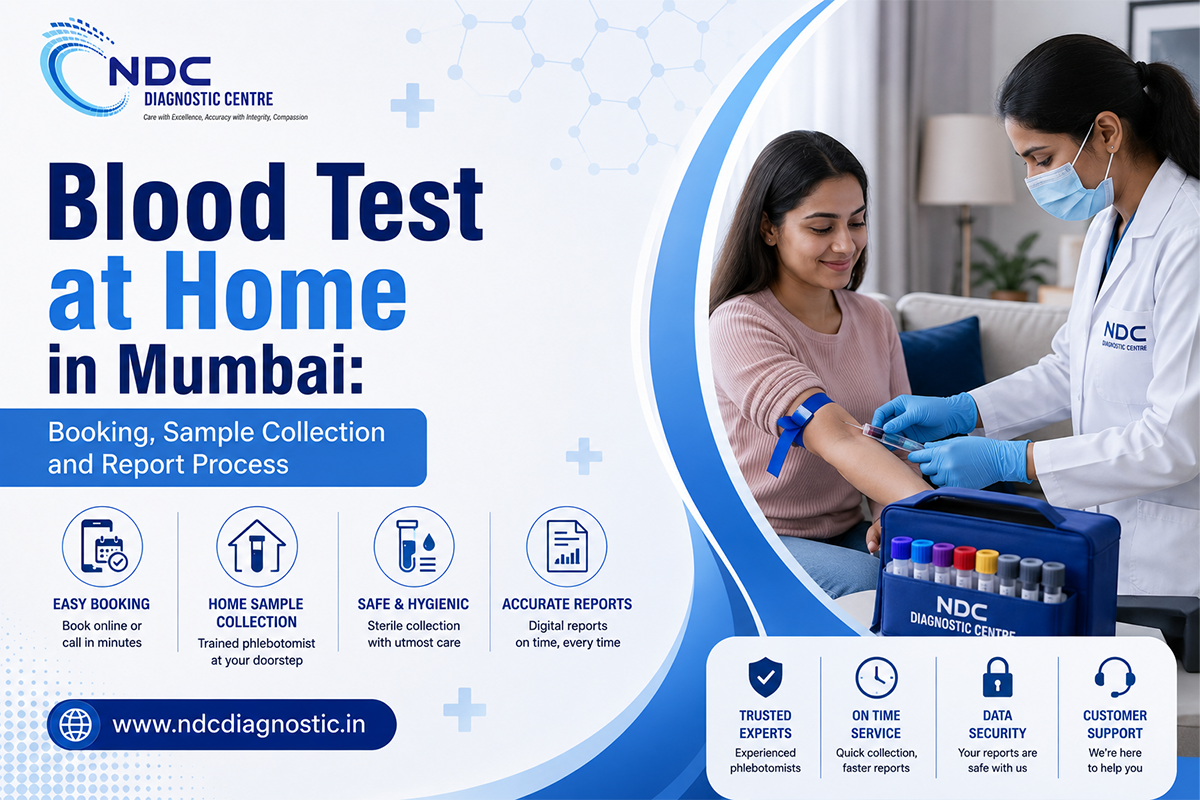
A blood test at home saves you a trip to a collection centre, but the actual laboratory process does not happen in your living room. A trained collection professional takes the required blood sample at your address, labels and prepares it for transport, and the specimen is then tested in a laboratory.
For the patient, the important parts happen before and after the blood draw too. The correct test needs to be booked, fasting instructions need to be followed where required, patient details need to match the test request, and the sample has to reach the laboratory under conditions suitable for that investigation.
If you are arranging a blood test at home in Mumbai, confirming these details before the appointment can prevent unnecessary repeat visits, incorrect preparation or confusion about the final price and report timing.
A home blood test usually means that the specimen is collected at your home rather than at a pathology collection centre.
The analysis still takes place in a laboratory.
The process generally has three separate stages:
This distinction matters because the quality of a blood test does not depend only on the moment the needle is used. The World Health Organization notes that collection tubes, patient and sample matching, transportation conditions and the collection process itself can all influence laboratory results.
Home collection is therefore best understood as an alternative place for specimen collection, not a different type of laboratory test.
The exact booking method differs by diagnostic provider, but the useful information to have ready is usually the same.
Start with the exact test or tests your doctor has requested. If you have a prescription, keep it available so the test names can be confirmed correctly.
You may also need to provide:
Before confirming the booking, ask whether home collection is available for the exact investigation you need.
A general request such as "full blood test" can create confusion because CBC, lipid profile, thyroid testing, blood glucose, vitamin tests and larger health packages are different investigations with different preparation and processing requirements.
Booking the appointment is only one part of preparing for home collection.
A few questions are worth resolving beforehand:
If several blood tests have been prescribed, ask whether all of them can be collected during the same visit.
That is especially useful for health packages because one test in the package may determine the preparation required for the entire collection.
Not every blood test requires fasting.
MedlinePlus advises that fasting should be done when it has been specifically requested for the test. When fasting is required, the exact duration depends on the investigation.
Certain blood glucose and lipid tests may require fasting depending on the test ordered and the clinical instructions. Many other blood tests may not.
This is why automatically fasting for 8 to 12 hours before every home blood collection is not a good approach.
Unnecessary fasting can also affect some results, so follow the instructions given for the actual test rather than applying one rule to every blood sample.
The same principle applies to health packages. Some NDC health check-up packages contain fasting glucose and lipid investigations and specify 10 to 12 hours of fasting for the package. That requirement belongs to the complete set of investigations rather than every individual blood test in isolation.
Plain water is generally allowed when you have been instructed to fast for a blood test.
MedlinePlus specifically states that water can be consumed during a blood-test fast and notes that being hydrated may also make it easier to obtain a blood sample.
Other drinks are different.
Coffee, tea, juice, milk and soft drinks should not be treated as substitutes for plain water during a prescribed fast because they may contain substances that affect the test.
Medicines require separate consideration.
Do not stop regular prescription medicines simply because you are fasting unless your healthcare professional has told you to do so. MedlinePlus recommends checking medication instructions with the healthcare provider and specifically advises against stopping medicines without medical guidance.
Once the collection professional arrives, the process should begin with confirming the patient and the requested investigations.
WHO phlebotomy guidance recommends matching the patient's identity with the laboratory request before blood is collected. It also recommends asking the patient to state their full name rather than relying only on assumptions or visual recognition.
For most routine venous blood tests, blood is drawn from a vein in the arm.
The process generally involves:
A blood draw may cause brief discomfort. Some people can also experience mild bruising or light-headedness afterwards.
If you have previously fainted during injections or blood collection, telling the collector before the procedure can help them plan the collection more appropriately. WHO guidance specifically includes asking patients about previous fainting, allergies and needle-related fears.
Correct patient identification may seem like a small administrative step, but it is part of laboratory quality.
Before the blood draw, the patient details should match the test request.
After collection, the sample needs to be identified correctly so that the laboratory can link the specimen with the right patient and the right investigation.
WHO guidance identifies patient and sample matching, including labelling, as one of the factors that can influence the quality of laboratory sampling. It also recommends rechecking specimen labels and forms before dispatch.
As a patient, you do not need to audit the laboratory process.
It is reasonable, however, to make sure the collector has:
This is particularly useful when several members of the same household are having blood samples collected during one visit.
The blood draw is only the beginning of the laboratory process.
After collection, the sample needs to reach the laboratory in a condition suitable for testing.
That can involve:
WHO guidance identifies transportation conditions as one of the factors that can affect laboratory results. It also describes clearly labelled containers and secure transport systems as part of good sample-transport practice.
There is no single transport condition that applies to every blood sample.
Some specimens have specific stability, timing or temperature requirements. This is why statements such as "all home blood samples are transported on ice" are misleading.
The correct requirement depends on the investigation.
The useful comparison is not simply home collection versus collection at a laboratory.
What matters is whether the specimen is collected, identified, handled and transported correctly before being tested.
WHO guidance identifies several factors that can influence the quality of laboratory sampling, including staff knowledge, correct collection tubes, patient-sample matching and transportation conditions.
If those steps are managed properly, the laboratory analysis itself follows the testing process used for that specimen.
Problems can occur in either setting if there are issues such as:
So a claim that home collection is automatically more accurate or less accurate than centre-based collection would be too simplistic.
The pre-analytical process matters in both settings.
Many routine pathology investigations use specimens that can potentially be collected through a home blood-draw service.
Common blood investigations include tests such as:
However, availability depends on the provider and the requirements of the exact investigation.
Some tests have specialised timing, collection, processing or handling requirements that can make home collection unsuitable or unavailable.
It is also important to distinguish blood testing from other diagnostic services.
An ECG, TMT, 2D Echo, ultrasound, X-ray or other procedure-based investigation is not simply a "blood test at home." Those procedures require their own equipment and clinical setup.
NDC lists a range of laboratory disciplines under its pathology services, including biochemistry, haematology, clinical pathology, histopathology, cytology, serology and immunology.
Confirm whether the specific test you need is eligible for home collection before booking.
Home collection can be practical for people who find travelling difficult, older adults, people with limited mobility, busy professionals or patients who need routine repeat blood testing.
That does not make it the right option for every investigation.
A centre visit may make more sense when:
Routine home sample collection is also not a substitute for urgent medical care.
If someone has severe, rapidly worsening or emergency symptoms, waiting for a routine blood collection appointment at home is not an appropriate replacement for prompt medical assessment.
There is no single universal home blood-test price in Mumbai.
The final amount can include two separate components:
The amount may vary based on:
This is why comparing two providers only by the advertised test price can be misleading.
Before confirming a booking, ask for the total amount for your specific test and address, including any home collection charge.
If you are booking through NDC, confirm the current test price, home collection availability and any applicable collection charges for your location before the appointment.
Report time varies by investigation.
A routine blood test, a specialised hormone assay and histopathology do not necessarily take the same amount of time to process.
Before collection, ask:
Avoid assuming that every home blood-test report will be available the same day or within 24 hours.
The correct turnaround time depends on what is being tested and the processing required.
Receiving the report is also different from interpreting it.
If a report contains abnormal or unfamiliar results, their significance depends on the individual test, symptoms, medical history and clinical context.
NDC Diagnostic Centre's Kurla location specifically lists Home Visit for Blood Sample Collection along with pathology services. The centre is located at Basement 1, CritiCare Asia Hospital, Kohinoor Hospital, Kurla Kirol Road, Mumbai.
You can review the NDC Diagnostic Centre in Kurla for branch information.
NDC also provides information about its wider pathology services and diagnostic centre locations.
If you want to arrange home blood sample collection, confirm:
This gives you a clearer picture of the complete process before the collection visit.
Start by confirming the exact blood test or health package you need, then check whether home collection is available for your address. Confirm the collection slot, preparation requirements, total price and expected report time before completing the booking.
Not every blood test requires fasting. Fasting depends on the investigation. If fasting has been prescribed, follow the exact duration given for that test.
Plain water is generally allowed during a prescribed blood-test fast unless you have received different instructions. Coffee, tea, juice and other drinks should not be treated as equivalent to water.
The collector confirms the patient and requested tests, prepares the required tubes, collects blood usually from a vein in the arm, labels the specimens and prepares them for transport to the laboratory.
The specimen is labelled, packaged and transported under conditions appropriate for the particular test. Different specimens may have different time and temperature requirements.
Reliability depends on correct collection, identification, labelling, storage, transport and laboratory testing. The collection location alone does not determine the quality of the result.
Some providers charge a separate home visit fee while others may include collection in the test or package price. Confirm the total amount, including any home collection charge, before booking.
There is no single turnaround time for every test. Report timing depends on the investigation and the processing required. Ask for the expected turnaround time when booking the exact test.
No. Many routine blood investigations may be suitable for home collection, but some tests have specific collection, timing or processing requirements. Confirm eligibility for the exact test before booking.