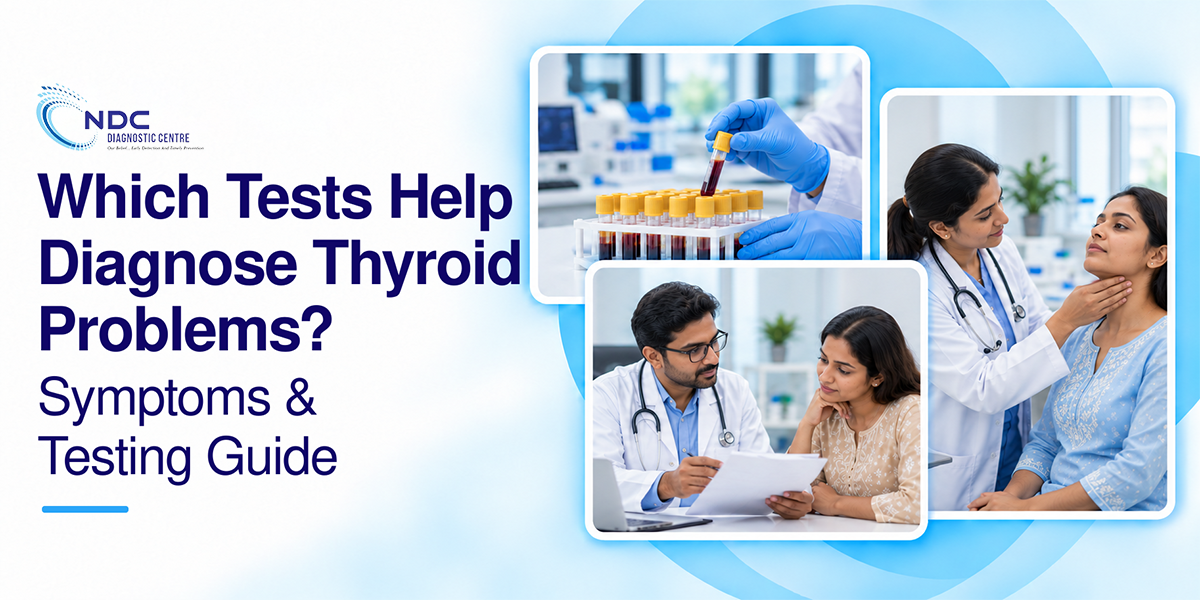
The thyroid is a small, butterfly-shaped gland located at the front of your neck, just below your Adam's apple. Even though it is small, it plays a very important role in your body. The thyroid gland produces hormones primarily thyroxine (T4) and triiodothyronine (T3) that control the speed of many body functions, including your heart rate, digestion, energy levels, and even your mood.
When the thyroid gland is not working properly, it can either produce too many hormones (a condition called hyperthyroidism) or too few hormones (called hypothyroidism). Both conditions can cause a wide range of health issues that affect your daily life. That is why the tests that help diagnose thyroid problems are so important they give doctors the information they need to understand what is happening inside your body and how to treat it correctly.
Thyroid disorders are one of the most common hormonal problems in India. It is estimated that over 42 million people in India suffer from some form of thyroid disease. Women are nearly 5 to 8 times more likely than men to develop thyroid problems, although men are certainly not immune to it.
Despite being so common, thyroid problems are frequently missed or misdiagnosed because the symptoms can look like many other health conditions. That is exactly why getting the right tests done and understanding what those tests mean is so important.
Before we get into which tests help diagnose thyroid problems, it helps to understand the warning signs your body might be sending you. The symptoms can vary depending on whether your thyroid is underactive or overactive.
If you are experiencing any of these symptoms, it is a good idea to speak to your doctor about getting a thyroid test done. Early detection can make a big difference in how well these conditions are managed.
Who Should Get Tested for Thyroid Problems?
Not everyone needs to get tested regularly, but there are certain groups of people for whom thyroid screening is especially important.
You should consider thyroid testing if you:
Doctors also routinely check thyroid function as part of a general health checkup, especially in older adults.
There is no single test that tells the whole story about your thyroid health. In most cases, doctors will order a combination of blood tests and imaging tests to get a complete picture. Here is a detailed look at all the major tests that help diagnose thyroid conditions.
TSH Test (Thyroid Stimulating Hormone)
The TSH test is almost always the first test a doctor orders when checking thyroid function. TSH is a hormone produced by the pituitary gland (a small gland in the brain). Its job is to tell the thyroid gland how much hormone to produce.
Normal TSH range: Approximately 0.4 to 4.0 mIU/L (this can vary slightly depending on the lab and the patient's age or pregnancy status).
The TSH test is highly sensitive and can detect thyroid problems even before symptoms appear. This makes it one of the most useful tools in early thyroid diagnosis.
Total T3 (Triiodothyronine) and Total T4 (Thyroxine) tests measure the total amount of these hormones in your bloodstream both those attached to proteins and those that are free.
These tests are often ordered alongside the TSH test to give a fuller picture of how well your thyroid is functioning.
Free T3 (FT3) and Free T4 (FT4) measure only the portion of these hormones that are NOT attached to proteins in the blood. This is important because only the "free" hormones are active and able to enter body cells and do their job.
Many doctors prefer Free T3 and Free T4 tests over total T3 and T4 because they give a more accurate reflection of actual hormone activity in the body.
Sometimes, the immune system mistakenly attacks the thyroid gland. This is known as an autoimmune thyroid disorder. The two main antibody tests used to check for this are:
These antibody tests are particularly helpful when:
Thyroglobulin is a protein made by the thyroid gland. In healthy individuals, small amounts of thyroglobulin are found in the blood. However, this test is mainly used as a tumor marker in people who have been treated for thyroid cancer.
After thyroid cancer surgery or radioactive iodine treatment, thyroglobulin levels should be very low or undetectable. Rising levels can indicate that the cancer has come back. This makes the thyroglobulin test an important part of long-term monitoring for thyroid cancer patients.
Calcitonin is another hormone produced by certain cells in the thyroid (called C-cells or parafollicular cells). Elevated calcitonin levels can be an early indicator of medullary thyroid cancer, a less common form of thyroid cancer.
This test is not part of a routine thyroid screening but may be ordered if:
A thyroid ultrasound is an imaging test that uses sound waves to create a picture of the thyroid gland. It does not involve radiation and is completely painless. This test is one of the most valuable tools when it comes to diagnosing structural problems with the thyroid.
What a thyroid ultrasound can detect:
At NDC Diagnostic, we provide high-quality radiology services including thyroid ultrasound with advanced imaging technology. You can learn more about our radiology services here.
A thyroid ultrasound is often done along with blood tests to get a complete picture of both the function and the physical structure of the gland.
If a thyroid nodule (lump) is found on an ultrasound and looks suspicious, your doctor may recommend a Fine Needle Aspiration (FNA) biopsy. This involves using a thin needle to take a small sample of cells from the nodule, which is then examined under a microscope.
FNA biopsy helps determine whether a thyroid nodule is:
This is currently the most reliable way to evaluate whether a thyroid nodule could be cancerous, and it plays a big role in determining the right course of treatment.
The Radioactive Iodine Uptake (RAIU) test measures how much iodine your thyroid absorbs over a certain period, usually 6 hours and 24 hours. The thyroid naturally absorbs iodine from the food you eat to make thyroid hormones.
This test is typically combined with a thyroid scan, which produces an image showing which parts of the thyroid are active. It is particularly useful in diagnosing the cause of hyperthyroidism.
It can be confusing to look at thyroid test results without understanding what they mean. Here is a simple breakdown:
|
Condition |
TSH Level |
T3/T4 Level |
|
Normal thyroid |
Normal (0.4–4.0 mIU/L) |
Normal |
|
Hypothyroidism |
High |
Low |
|
Hyperthyroidism |
Low |
High |
|
Subclinical Hypothyroidism |
Slightly High |
Normal |
|
Subclinical Hyperthyroidism |
Slightly Low |
Normal |
Subclinical conditions are early-stage disorders where symptoms may be mild or absent, but blood tests already show early changes. Catching these early with regular testing is one of the best ways to prevent progression to a full-blown thyroid disorder.
Understanding what "normal" means for thyroid tests is not always straightforward because reference ranges can vary based on:
General reference ranges (approximate):
Always review your test results with your doctor. A value that falls slightly outside the reference range does not necessarily mean something is seriously wrong, but it does warrant attention and possibly repeat testing.
Thyroid health is especially important during pregnancy. Thyroid hormones are critical for the normal brain development and growth of the baby, particularly in the first trimester when the baby cannot yet produce its own thyroid hormones.
Pregnancy-specific concerns include:
Because of these risks, many doctors recommend thyroid testing:
TSH reference ranges are different during pregnancy generally, lower TSH values are expected so it is important that your doctor interprets your results using pregnancy-specific reference ranges.
Thyroid disorders can also affect children, though this is less common than in adults. In India, newborn thyroid screening (neonatal TSH screening) is increasingly being recommended to detect congenital hypothyroidism early, as this condition can cause intellectual disability if left untreated.
Signs that a child may have a thyroid problem include:
If you notice any of these signs in your child, do not wait. Speak to your pediatrician about getting thyroid tests done early.
The frequency of thyroid testing depends on your personal health history and risk factors.
General guidelines:
If you have any symptoms or risk factors mentioned earlier, you should not wait for a scheduled check. Get tested sooner.
When it comes to diagnosing thyroid conditions accurately and quickly, the quality of your diagnostic center matters a great deal. At NDC Diagnostic, we understand how important it is to have reliable, accurate results that your doctor can trust.
Here is why thousands of patients across Maharashtra choose NDC Diagnostic:
We offer a full range of thyroid blood tests including TSH, Free T3, Free T4, Total T3, Total T4, Anti-TPO, Anti-Thyroglobulin, Thyroglobulin, and Calcitonin tests. Our pathology services are backed by experienced lab professionals and modern equipment that ensures accurate and timely results.
Our radiology department offers high-resolution thyroid ultrasounds and other imaging services performed by qualified radiologists. We use advanced technology to give you the clearest possible picture of your thyroid health.
We know that getting to a diagnostic center should be easy and convenient. That is why NDC Diagnostic has multiple branches across the Mumbai Metropolitan Region:
Whether you live in Navi Mumbai, Thane, or the suburbs, there is an NDC Diagnostic center near you. You can simply walk in or book an appointment for a smooth and hassle-free testing experience.
We know waiting for test results can be stressful. That is why we work hard to deliver accurate reports quickly, including digital reports that you can access and share with your doctor right away.
Our team of lab technicians, radiologists, and support staff are trained to help you feel at ease. We believe that good diagnostics go hand in hand with good patient care.
Conclusion
Thyroid problems are incredibly common, but the good news is that they are also very manageable especially when detected early. The tests that help diagnose thyroid conditions range from simple blood tests like the TSH test to more detailed investigations like thyroid ultrasound and antibody tests. Together, these tests give your doctor a full, clear picture of your thyroid health.
Here is a quick summary of what we covered:
If you have been feeling off lately and cannot quite explain why, it might be worth getting your thyroid checked. It is a simple blood test that can make a big difference.
Ready to get tested? Visit your nearest NDC Diagnostic center today. We offer accurate, affordable thyroid testing with quick results and caring service at locations in Seawoods, Kharghar, Kalyan, Kurla, and Thane (Khopat). Your health is worth it don't wait.
For more information about our services, visit ndcdiagnostic.in or walk into the branch nearest to you. Our team is always ready to help you take that important step toward better health.
Disclaimer: This blog post is intended for general informational purposes only and is not a substitute for professional medical advice, diagnosis, or treatment. Always consult your doctor or a qualified healthcare professional with any questions you may have regarding a medical condition.