
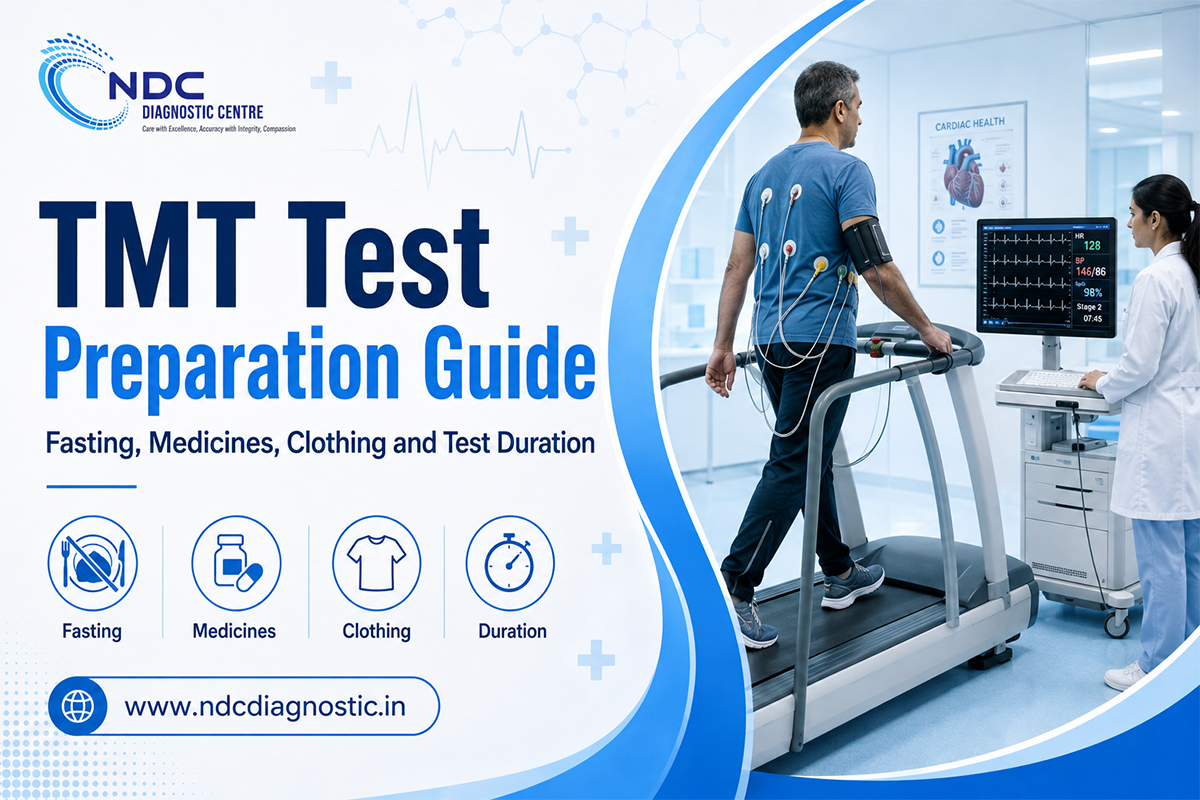
Your doctor has recommended a treadmill stress test also called a TMT or exercise stress test and your appointment is coming up. Questions about what to eat, which medicines to take, what shoes to wear and how long the test takes are completely normal. Good preparation helps the test run smoothly and reduces unnecessary anxiety on the day.
One important thing to understand from the start: preparation instructions for a TMT can vary depending on your medical history, your medicines and the protocol followed by your centre. This guide covers everything from the evening before your test to recovery afterward, but always follow the specific instructions provided by your doctor or diagnostic centre. For patients looking at TMT and cardiology tests at NDC Diagnostic Centre, details about available services, locations and appointment guidance are available on their cardiology page.
|
Question |
Quick Answer |
|
Can I eat before TMT? |
Follow your doctor's or centre's specific eating instructions. Avoid a heavy meal close to the test. |
|
Can I drink coffee or tea? |
Caffeine restrictions may apply. Confirm your specific instructions with the centre before your appointment. |
|
Should I stop medicines? |
Never stop prescribed medicines on your own. Always follow your doctor's instructions. |
|
What should I wear? |
Comfortable, lightweight, exercise-friendly clothing. |
|
What shoes should I wear? |
Comfortable walking or running shoes with good grip. |
|
What should I carry? |
Doctor's prescription, previous cardiac reports if available, medicine details and your inhaler if used. |
|
How long does TMT take? |
Total appointment is typically around one hour. Active exercise is usually around 15 minutes, though this varies. |
The evening before your test is a good time to get organised rather than leaving things to the morning.
You may be asked not to eat or drink for a period before an exercise stress test, but the exact instruction depends on your test protocol and centre. The Mayo Clinic advises following the preparation instructions given by your healthcare professional rather than assuming one universal fasting period applies to everyone.
What most healthcare professionals agree on is this:
Follow the exact fasting instructions provided by your doctor or NDC centre. If you have not received clear instructions, contact the centre before your appointment day.
Healthcare professionals may advise avoiding caffeine before some stress tests, as caffeine can affect heart rate and may influence test findings. However, instructions vary by stress-test type and centre.
Common sources of caffeine to be aware of include:
If your instructions do not specifically mention caffeine, contact the testing centre to clarify before your appointment. Do not be alarmed if you accidentally consumed a small amount simply inform the healthcare team when you arrive.
Do not stop, skip or change any prescribed medicine on your own before a TMT test.
Certain medicines can affect how the heart responds during exercise testing. Because of this, your healthcare professional may sometimes give specific instructions about medication timing before the test. The Mayo Clinic advises patients to ask their healthcare professional directly whether they should take their regular medicines on the day of the test.
Things to keep in mind:
"Some medicines, including certain heart-rate-lowering medicines, can influence stress-test results. Your doctor will decide whether any medication needs adjustment before your test."
If you are unsure about any medicine, call your doctor or the diagnostic centre ahead of time.
Getting your clothing right is one of the simplest things you can do to make the test more comfortable.
Clothing:
Footwear:
The Mayo Clinic recommends comfortable clothes and walking shoes for exercise stress testing. The American Heart Association explains that an exercise stress test involves cardiac monitoring as exercise intensity gradually increases — your clothing and shoes should support that activity comfortably.
Use this as a quick checklist before leaving home:
If you want to understand the treadmill stress test in more detail before your appointment, you can also learn more about the treadmill stress test in NDC's dedicated overview article.
Here is what typically happens on test day:
After you arrive and register, a healthcare professional will review your symptoms, medical history, current medicines and exercise ability. This is also the right time to mention any recent symptom changes or concerns.
Small adhesive electrodes are placed on your chest to record ECG signals throughout the test. In some cases, a small amount of body hair may need to be shaved in the electrode placement area so they adhere properly. This is routine and takes only a few minutes.
Before exercise begins, your resting heart rate, ECG and blood pressure are recorded as a baseline for comparison.
The treadmill starts at a comfortable, slow pace. The speed and incline are gradually increased at set intervals. Throughout this period, your heart rate, heart rhythm, ECG and blood pressure are continuously monitored. The American Heart Association notes that monitoring continues as exercise workload gradually increases.
The exercise phase may be stopped when:
You do not need to push through any significant symptoms. Inform the healthcare team immediately if you feel chest discomfort, severe breathlessness, dizziness or any other concerning symptom during the test.
After exercise stops, you will rest while your heart rate and blood pressure continue to be monitored during recovery. The Mayo Clinic notes that patients are observed as heart rate and breathing return toward resting levels.
It is helpful to understand the difference between total appointment time and active exercise time.
The treadmill walking portion of the test typically lasts around 10 to 15 minutes, though this depends on your exercise capacity and when the test's clinical goals are met. Some patients may exercise for a shorter or longer period.
When you include registration, the medical review, electrode placement, baseline measurements, the exercise phase and recovery monitoring, the total appointment commonly takes approximately one hour, according to Mayo Clinic guidance. However, individual timing varies.
Your actual appointment duration can vary depending on preparation, exercise capacity, clinical findings and the centre's workflow. Confirm the expected appointment time with your selected NDC branch when you book.
These are the preparation errors that cause the most problems — and all are easily avoidable.
Once the exercise phase ends, you will be asked to rest. Your heart rate and blood pressure will continue to be monitored until they return toward your resting levels. Most patients feel fine after the test and can return to their normal activities, unless the healthcare team advises otherwise.
Report interpretation depends on the findings and will be done by your doctor. Do not rely on how you felt during the test as a measure of the result the clinical interpretation involves ECG changes, heart rate response, blood pressure behaviour and other factors assessed by a qualified professional.
Inform the team at the diagnostic centre if:
The healthcare team can factor this information into how the test is conducted. There is no reason to withhold it.
If your doctor has recommended a treadmill stress test, you can explore NDC Diagnostic Centre's cardiology services, which include computerised stress testing alongside ECG, 2D Echo, Holter monitoring and blood pressure monitoring.
Before your visit, confirm preparation instructions, medication guidance, test availability and appointment timing directly with your preferred branch. NDC offers TMT testing at several centres including Kharghar and Seawoods. Contact your nearest centre to discuss your specific requirements before your appointment.
There is no single universal fasting period that applies to every patient or every centre. The Mayo Clinic advises following the preparation instructions provided by your healthcare professional. Some centres specify a period of avoiding food and drink before the test, while others focus primarily on avoiding a heavy meal immediately before exercise. Contact your doctor or the diagnostic centre to confirm the exact instruction for your appointment.
Whether you can drink water before your test depends on the specific instructions from your doctor or centre. Some protocols permit water; others may ask you to avoid all food and drink including water for a period before the test. Do not assume either way check with the centre when you confirm your appointment.
Do not stop, skip or change your blood pressure medicine without a specific instruction from your healthcare professional. Certain medicines can influence the stress-test response, and your doctor will advise whether any adjustment is needed for your particular situation. Acting on your own without guidance is not safe.
Caffeine may be restricted before some stress tests, as it can affect heart rate and potentially influence test findings. However, this varies by test type and centre. Check your preparation instructions, and if caffeine is not mentioned, contact the centre to clarify before your appointment day.
Wear lightweight, comfortable clothing that allows free movement — sportswear or casual exercise clothes are suitable. More importantly, wear comfortable walking or running shoes with good grip. Avoid formal shoes, sandals, slippers or heels. Electrodes will be placed on your chest during the test, so wear clothing that allows easy chest access for the healthcare team.
The active treadmill walking portion typically lasts around 10 to 15 minutes, depending on your exercise capacity and the test goals. However, the total appointment — including registration, medical review, electrode placement, baseline measurements and recovery monitoring commonly takes approximately one hour, according to Mayo Clinic guidance. Individual timing can vary, so confirm the expected duration with your selected NDC branch.