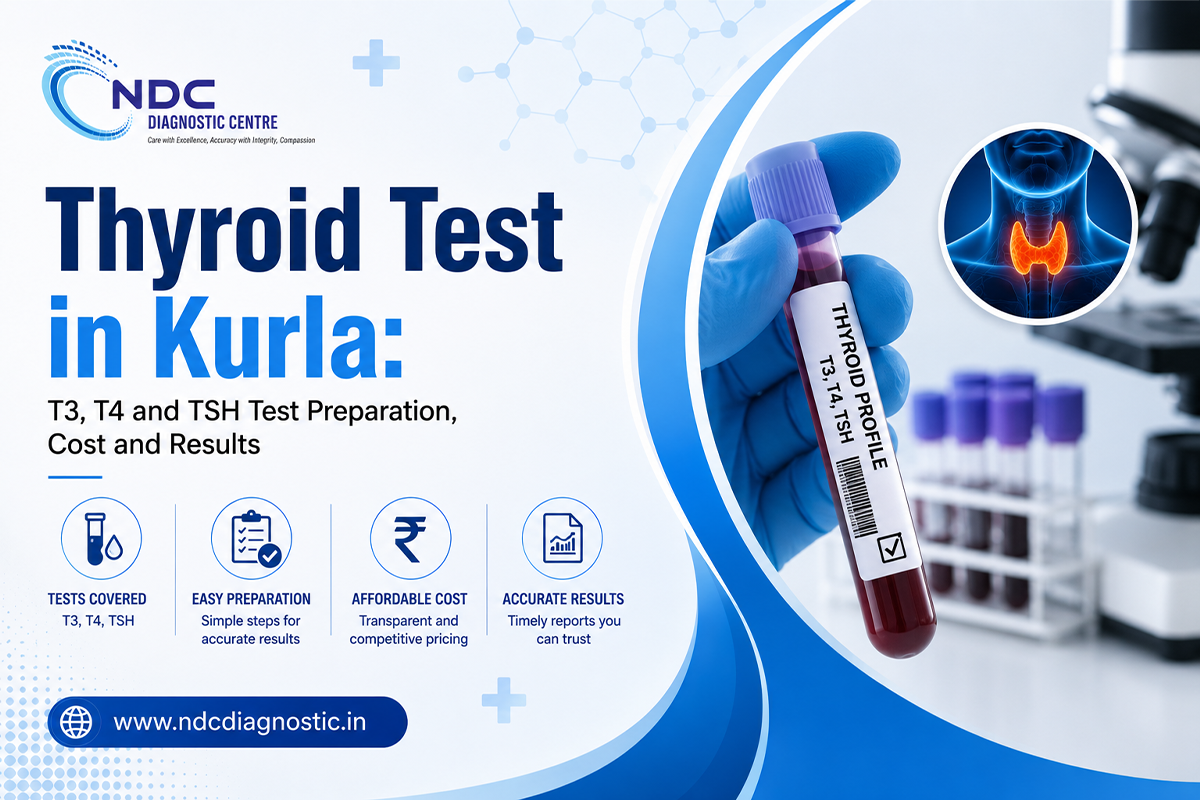
If your doctor has written T3, T4 and TSH on a blood-test prescription, the three names can look like separate tests. In practice, they are often measured together as a thyroid profile, although some people may need only TSH or a profile containing Free T3 and Free T4 instead.
Preparation for a routine thyroid blood test is usually simple. Fasting is generally not required for a standalone TSH or common thyroid profile, although it may be necessary if other fasting blood tests are being done at the same visit. The price also depends on the panel ordered. A TSH-only test, Total T3/T4/TSH profile and FT3/FT4/TSH profile are different tests and should not be compared as though they are identical.
For patients looking for a thyroid test in Kurla, understanding the exact panel on the prescription is the best place to start.
A thyroid function test is a blood test used to assess how the thyroid system is working.
The most commonly discussed measurements are TSH, T4 and T3, but they do not all come from the same place or provide exactly the same information.
TSH stands for thyroid-stimulating hormone. Despite its name, TSH is not produced by the thyroid gland. It is produced by the pituitary gland in the brain.
Its job is to signal the thyroid to make thyroid hormones.
When circulating thyroid hormone levels are lower than the body needs, the pituitary generally responds by producing more TSH. When thyroid hormone levels are high, TSH production usually falls. This feedback relationship is one reason TSH is commonly used as an initial test of thyroid function.
TSH is very useful, but it should not be treated as a standalone answer in every clinical situation. Other measurements, particularly Free T4, can provide important context when a TSH result is abnormal or when the clinical picture is unusual.
T4, or thyroxine, is the main thyroid hormone produced by the thyroid gland. Much of the T4 circulating in blood is attached to proteins.
A laboratory may measure:
The American Thyroid Association notes that Free T4 used together with TSH often gives a clearer picture of thyroid function because total hormone levels can be influenced by changes in binding proteins.
T3, or triiodothyronine, is another thyroid hormone. Much of the body's T3 is produced when T4 is converted into T3 in other tissues.
T3 testing can be particularly useful when hyperthyroidism is suspected. In some people, T3 becomes elevated while Free T4 remains within range.
T3 is generally less useful for identifying hypothyroidism because it can remain within the laboratory reference interval even when thyroid function is significantly reduced.
This distinction matters both medically and when comparing thyroid-test prices.
A Total T3 or Total T4 test measures both the hormone attached to proteins and the small portion circulating freely in the blood.
FT3 and FT4 measure the free, unbound forms.
That means these two commonly advertised profiles are not the same:
Total thyroid profile
T3 + T4 + TSH
Free thyroid profile
FT3 + FT4 + TSH
One is not automatically better than the other. The appropriate panel depends on what the clinician wants to assess.
Binding proteins can change during pregnancy and with oestrogen exposure, which can affect Total T3 and Total T4 even when actual thyroid function has not changed in the same way. This is one reason Free T4 can sometimes provide more useful information alongside TSH.
If you are comparing two thyroid-profile prices, check whether both providers are quoting the same panel.
Thyroid testing can be used for several different clinical reasons.
A doctor may order TSH or a thyroid profile when symptoms or examination findings raise a question about thyroid function. It can also be used to monitor an existing thyroid condition or check the response to thyroid medication.
Possible reasons include:
Symptoms such as fatigue, weight change, heat or cold intolerance, changes in heart rate, constipation, anxiety or menstrual changes can occur with thyroid disorders, but they are not specific to thyroid disease.
A blood test is therefore interpreted together with symptoms, medical history and other clinical findings rather than using one symptom as a diagnosis.
For a standalone TSH test or routine thyroid profile, fasting is generally not required.
MedlinePlus states that no specific preparation is needed for a TSH test itself. If other blood investigations have been ordered at the same time, however, fasting may be needed for those tests.
Current Mumbai listings for both Total T3/T4/TSH and FT3/FT4/TSH also describe these profiles as requiring no special preparation.
This distinction is important when a thyroid test is part of a broader health check-up.
Some NDC health check-up packages include TSH or T3, T4 and TSH along with tests such as fasting blood sugar and lipid profile. Those packages instruct patients to fast because of the combined investigations, not because every standalone thyroid test itself requires 10 to 12 hours of fasting.
If you are having multiple blood tests in one visit, follow the preparation instructions for the entire set of investigations.
A thyroid report can be influenced by more than thyroid function itself. Medicines, supplements, pregnancy and test timing can all affect how results are interpreted.
Biotin deserves special attention because it is commonly found in supplements marketed for hair, skin and nails.
Biotin can interfere with some laboratory methods used for thyroid testing and make results appear abnormal even when the true hormone levels are different.
The American Thyroid Association advises avoiding biotin for at least two days before thyroid-function testing to reduce this interference. MedlinePlus also recommends telling your healthcare provider if you take biotin before thyroid testing.
If you use biotin or a multivitamin containing it, follow the instructions given by your clinician or laboratory rather than changing supplements without checking.
Several prescription medicines can affect thyroid-test results or their interpretation.
This does not mean those medicines should automatically be stopped.
Tell your doctor or the testing team about the medicines and supplements you take. MedlinePlus specifically advises patients not to stop medication unless their healthcare provider tells them to do so.
Pregnancy can change thyroid-binding proteins and alter Total T3 and Total T4 measurements.
Pregnancy also has its own thyroid-testing considerations, so results should be interpreted using appropriate clinical and laboratory context rather than comparing them blindly with a general online reference range.
There is no good universal rule that every patient should take or skip thyroid medication at exactly the same point before testing.
The timing may depend on the medicine, the reason for testing and how your clinician prefers to monitor treatment.
If you take thyroid medication:
The safest approach is consistency with your treatment plan, not adjusting medication based on general advice found online.
TSH levels can vary during the day.
MedlinePlus notes that TSH values have daily variation and may be higher or lower depending on the time the sample is taken.
That does not mean a thyroid test taken later in the day is automatically invalid.
For someone having repeated tests to monitor treatment, collecting samples at a reasonably consistent time can sometimes make comparisons easier. Your clinician may also give specific timing instructions based on the reason for testing.
If no special timing has been advised, follow the collection instructions provided for your test.
T3, T4 and TSH are measured from a blood sample.
A healthcare professional usually collects a small amount of blood from a vein in your arm using a needle. The blood is transferred into a collection tube and sent to the laboratory for analysis.
The collection itself usually takes only a few minutes. MedlinePlus describes TSH testing as a standard venous blood draw.
There is no scan, injection of imaging contrast or other imaging procedure involved.
You can review NDC's pathology services for information about its laboratory-testing services. The NDC website identifies its Kurla location as a pathology centre.
There is no single thyroid-test price because "thyroid test" can refer to several different panels.
Current online prices in Mumbai illustrate the difference.
|
Thyroid test |
Current online price reference |
|
TSH Ultrasensitive only |
Around ₹339 on Tata 1mg |
|
Total T3 + T4 + TSH |
Around ₹490 on Tata 1mg |
|
Total T3 + T4 + TSH |
Around ₹719 on Apollo 24 |
|
FT3 + FT4 + TSH |
Around ₹719 on Tata 1mg |
|
FT3 + FT4 + TSH in Kurla |
Around ₹1,059 on Apollo 24 |
These are current online market references and promotional/listed prices can change.
The price difference is not just about the laboratory.
A TSH-only test contains one measurement. A Total T3/T4/TSH profile contains three. A Free FT3/FT4/TSH profile measures different hormone fractions. Larger panels can also include thyroid antibodies or both total and free hormones.
For example, Apollo currently lists a broader thyroid profile with total hormones, free hormones and thyroid antibodies separately from the basic three-test profiles.
Before comparing prices, read the exact test name on your prescription.
If you are planning testing at the NDC Diagnostic Centre in Kurla, confirm the exact thyroid panel, current price and preparation requirements before your visit.
Thyroid results should not be interpreted by looking at one number in isolation.
The report needs to be considered alongside:
Laboratory methods and reference intervals can vary, which is why copying a "normal TSH, T3 or T4 range" from another website can create confusion.
In the common pattern of primary hypothyroidism, TSH often rises because the pituitary is signalling the thyroid to produce more hormone.
The rest of the thyroid profile matters.
For example, the combination of elevated TSH with low Free T4 is different from elevated TSH with Free T4 that remains within the laboratory reference interval.
A high TSH should therefore not be treated as a complete diagnosis without considering the accompanying thyroid hormone measurements and clinical context.
TSH commonly becomes low when circulating thyroid hormone levels are high, such as in many cases of hyperthyroidism.
But a low TSH can also occur in other clinical circumstances, including some pituitary-related conditions and effects from medicines or treatment. T3 and Free T4 can help clarify the pattern.
Again, the result pattern matters more than one isolated number.
TSH shows how strongly the pituitary is signalling the thyroid.
Free T4 gives information about the circulating unbound T4 available to tissues.
Reading them together helps clinicians distinguish several common patterns of thyroid dysfunction and can provide more useful information than either measurement alone.
T3, T4 and TSH are not the only blood tests related to the thyroid.
Depending on the reason for testing, a clinician may request other investigations such as:
Antibody tests can be useful in particular autoimmune thyroid conditions, but they are not automatically required for every person undergoing a thyroid profile.
This is another reason a larger "thyroid package" should not be assumed to be more appropriate than a basic profile. The useful test is the one that answers the clinical question.
NDC's Kurla centre is located at Basement 1, CritiCare Asia Hospital, Kohinoor Hospital, Kurla Kirol Road, Mumbai 400070. Its current centre page lists pathology services and home visits for blood sample collection.
If your doctor has advised TSH, T3/T4 or another thyroid profile, confirm the exact panel before collection because Total T3/T4/TSH and FT3/FT4/TSH are different tests.
You can review the NDC Diagnostic Centre in Kurla, explore NDC's pathology services, or check NDC diagnostic centre locations before your visit.
Confirm the current test price, preparation requirements and availability for the exact thyroid panel written on your prescription.
A thyroid test is usually a blood test that measures hormones involved in thyroid function. Common tests include TSH, Total or Free T4, and Total or Free T3.
Fasting is generally not required for a standalone routine thyroid profile. If thyroid testing is being done together with fasting glucose, lipid profile or another test requiring fasting, follow the preparation instructions for the full set of investigations.
A routine thyroid blood test generally does not require fasting, so normal water intake is usually not restricted unless you have received different preparation instructions for another test being performed at the same time.
TSH is a single measurement of thyroid-stimulating hormone. A thyroid profile may include TSH together with T3 and T4 or with FT3 and FT4, depending on the panel ordered.
Total T3 and T4 include both protein-bound and free hormone. FT3 and FT4 measure the free, unbound portion. They are different tests and should not be treated as interchangeable panels.
Yes. Biotin supplements can interfere with some thyroid laboratory tests and create misleading results. Tell your healthcare provider or laboratory if you take biotin. The American Thyroid Association advises avoiding biotin for at least two days before thyroid-function testing.
Do not change the timing or dose of thyroid medication without medical advice. Ask your treating clinician if medication timing matters for the specific test or monitoring plan.
High TSH can occur when the thyroid is not producing enough hormone in common forms of primary hypothyroidism, but interpretation depends on Free T4 or other thyroid results, medicines and the clinical context.
The cost depends on the exact test. Current Mumbai and Kurla online listings show different prices for TSH-only testing, Total T3/T4/TSH and FT3/FT4/TSH profiles. Confirm the current price for the exact panel prescribed before booking.