
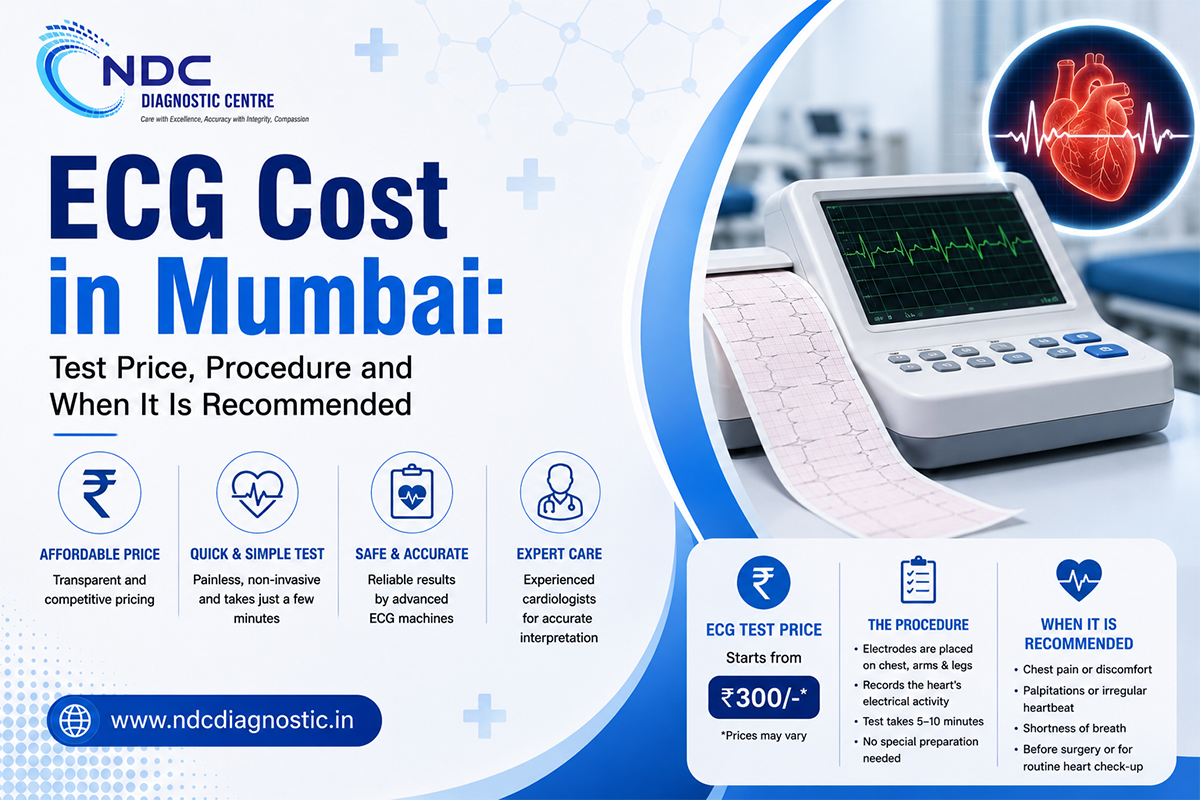
If your doctor has advised an ECG, the first practical questions are usually how much it costs and what the test can actually tell you.
Current Mumbai online listings in September 2026 show basic resting ECG prices starting at about ₹180 to ₹360 at selected providers. Tata 1mg currently lists ECG at a centre from ₹180, Aarthi Scans lists electrocardiography at ₹250 in Mumbai, and VRX Healthcare lists a 12-lead ECG at ₹360. These are market references, not NDC Diagnostic Centre prices, and promotional rates or inclusions can change.
A standard resting ECG is a quick, non-invasive test that records the heart's electrical activity. It can help assess heart rate, rhythm and electrical conduction, but it does not directly create images of the heart or map coronary artery narrowing.
Current online listings suggest that a basic resting ECG in Mumbai can start from roughly ₹180 to ₹360 at selected diagnostic providers.
|
Mumbai price reference |
Current listed price |
|
Tata 1mg ECG at centre |
Starts around ₹180 |
|
Aarthi Scans electrocardiogram |
Around ₹250 |
|
VRX Healthcare 12-lead ECG |
Around ₹360 |
These prices are useful for market comparison, but they are not identical offers. One provider may be showing a promotional starting rate, while another may include reporting or a different service setup.
Before booking, confirm the exact test and what the quoted amount includes.
For a standard resting ECG, the service generally involves:
A consultation may be separate from the ECG charge.
Price alone does not tell you whether two ECG services are exactly the same, so it is better to compare the test type and inclusions rather than choosing only by the lowest displayed amount.
ECG stands for electrocardiogram. You may also see the abbreviation EKG. Both names refer to the same test.
Every heartbeat is controlled by electrical signals moving through the heart. An ECG detects these signals through electrodes placed on the skin and records them as wave patterns.
The test can provide information about:
The American Heart Association's ECG guidance explains that an ECG records the electrical activity of the heartbeat. The machine only records these signals and does not send electricity into the body.
An ECG is therefore different from an echocardiogram. A 2D Echo uses ultrasound to show the heart's structure and movement, while an ECG records electrical activity.
A resting ECG can help clinicians identify or assess several types of electrical abnormalities.
These may include:
An ECG is an important cardiac test, but it does not detect every heart problem.
Its usefulness depends on what is happening at the time of the recording and what the clinician is trying to investigate.
For example, an irregular rhythm that happens only occasionally may not appear during a short resting ECG. In that situation, longer rhythm monitoring may sometimes be considered.
A standard resting ECG does not directly show or map narrowing inside the coronary arteries.
It records the electrical activity of the heart rather than producing an image of the arteries.
An ECG can sometimes show electrical changes associated with reduced blood flow to the heart muscle or a heart attack. However, a normal resting ECG does not rule out coronary artery disease or every form of acute coronary syndrome.
This distinction matters because patients sometimes interpret a normal ECG as proof that there is no blockage.
Whether additional testing is needed depends on factors such as:
If someone has new or severe chest pain, severe breathlessness, fainting or other potentially serious symptoms, routine diagnostic-centre booking should not delay urgent medical assessment.
An ECG may be advised when a healthcare professional needs information about the heart's rhythm or electrical activity.
Common clinical reasons can include assessment of:
These symptoms do not automatically mean a person has heart disease, and an ECG is not necessarily the only test that may be needed.
The test is chosen according to the clinical question.
For a standard resting ECG, you usually lie on an examination couch while electrodes are placed on the skin.
The process typically involves:
If there is a lot of chest hair where the electrodes need to be placed, a small area may sometimes need to be trimmed so the pads stick properly.
Talking or moving during the recording can interfere with the tracing, so you may be asked to remain relaxed and still for a short time.
The ECG machine does not give an electric shock. The electrodes are sensors that detect the electrical activity already produced by your heart.
A routine resting ECG is usually quick.
The actual electrical recording takes only a short time, although the total appointment may be longer because of:
This should not be confused with other cardiac tests.
A treadmill test involves exercise and takes longer. A Holter monitor records the heart's rhythm continuously over a much longer period.
Fasting is generally not required before a standard resting ECG.
For a routine ECG, people can usually eat and drink normally unless they have received different instructions because another test is being done at the same appointment.
This distinction matters when an ECG is part of a health check-up package.
Some NDC health check-up packages include ECG together with fasting blood glucose, lipid profile and other laboratory investigations. Those packages may require fasting because of the blood tests, not because a resting ECG itself requires an empty stomach.
For routine preparation, the Mayo Clinic ECG guidance states that no special preparation is usually needed for a standard electrocardiogram.
If your appointment includes an exercise ECG or TMT instead of a resting ECG, preparation instructions can be different.
A standard ECG usually requires very little preparation.
A few practical steps can make the appointment easier:
Do not stop prescribed medicines on your own before an ECG.
Instructions about caffeine, exercise or heavy meals may apply to an exercise ECG or treadmill test rather than to a simple resting ECG, so follow the preparation advice for the exact cardiac test you are having.
These tests are sometimes discussed together, but they provide different types of information.
|
Test |
What it mainly measures |
Typical role |
|
ECG |
Electrical activity during a short recording |
Heart rate, rhythm and conduction |
|
2D Echo |
Heart structure and movement using ultrasound |
Chambers, valves, wall motion and pumping function |
|
TMT |
ECG and clinical response during exercise |
How the heart responds to physical stress |
|
Holter monitor |
Electrical rhythm over a longer period |
Detecting intermittent rhythm problems |
None of these tests is automatically better than the others.
A resting ECG may be enough for one clinical question, while another patient may need structural imaging, exercise testing or prolonged rhythm monitoring.
For a more detailed comparison, see NDC's guide to ECG vs 2D Echo vs TMT.
A normal resting ECG means the short recording did not show certain electrical abnormalities at that time.
It does not guarantee the absence of:
This is particularly relevant for rhythm problems that come and go.
A brief ECG records only a small window of time. If symptoms are intermittent, a clinician may sometimes recommend longer monitoring such as a Holter monitor.
Similarly, a normal ECG should not be used by itself to rule out a heart attack or other urgent cardiac problem when symptoms and clinical findings remain concerning.
An ECG tracing contains several waves, intervals and patterns.
When interpreting the test, a healthcare professional may assess:
Patients may see terms such as sinus rhythm, ST changes, conduction delay or other technical descriptions on a report.
These findings should not be interpreted from a generic online chart because their significance depends on the complete tracing, symptoms, medical history and other clinical information.
NDC Diagnostic Centre lists ECG among its cardiology services, together with computerised stress testing, 2D Echo, BP monitoring and Holter monitoring.
Because cardiac-test availability can vary by location, check the NDC diagnostic centre locations and confirm that the prescribed ECG is available at your preferred centre before visiting.
If your doctor has advised an ECG, confirm:
This is especially important if the prescription mentions TMT, Holter monitoring or 2D Echo rather than a standard resting ECG.
Current online listings in Mumbai show basic resting ECG prices starting from approximately ₹180 to ₹360 at selected providers. The final cost can vary depending on the centre, promotional pricing and what is included in the service.
Yes. ECG and EKG are two abbreviations for electrocardiogram. Both refer to the same test that records the heart's electrical activity.
Fasting is generally not required for a standard resting ECG. If the ECG is part of a health package containing fasting blood tests, follow the preparation instructions for the complete appointment.
For a routine resting ECG, you can generally eat normally unless your healthcare team has given you different instructions for another test being done at the same visit.
A resting ECG recording itself usually takes only a few minutes. The complete appointment can take longer because of preparation, electrode placement and any need to repeat the tracing.
A resting ECG does not directly show narrowing inside the coronary arteries. It may show electrical changes associated with reduced blood flow or heart injury, but a normal ECG does not rule out coronary artery disease.
A standard ECG is non-invasive and generally painless. Some people may notice mild discomfort when the adhesive electrodes are removed.
No. ECG electrodes only detect the electrical signals produced by the heart. The ECG machine does not send electricity into the body.
An ECG records the heart's electrical activity, while a 2D Echo uses ultrasound to show the heart's physical structure, valves, movement and pumping function.